Swedish Military
Handling the UndeadThe Swedish Military becomes a visible instrument of the authorities’ response to the return of the dead: its personnel open graves, restrain those who emerge, and later relocate the reliving from Danderyd Hospital to the Heath. The contrast between these operations defines its role in the crisis. At the cemetery, military control is improvised in the face of bodies that move and flee; in the later relocation, the operation is presented as a necessary step toward separation, care, and rehabilitation.
Grave-Opening Operation
The military’s first major action described here takes place at Stockholm Forest Cemetery, where cadets begin examining at least 200 graves. The emergency is made concrete by the first body uncovered: an 87-year-old man who had been dead for six weeks, whose remains were already in an advanced state of decomposition. He was alive and tried to escape. When touched, sections of flesh peeled away; soldiers used his burial shroud to force him to the ground, and two people were needed to restrain him. The scene challenges the ordinary distinction between a buried corpse and a living person before the operation has progressed far.
The response relies on immediate physical containment. Army engineers erect an enclosure, while other personnel dig up coffins without opening them. Colonel Johan Stenberg describes the fence as having no alternative, though only as a temporary measure. His qualification captures the operation’s improvised character: the military can build a boundary and assign personnel to guard it, but the fence is a provisional answer to a phenomenon for which the authorities have no established procedure. Stenberg also says the soldiers had expected the dead to try to escape and that this is why so many personnel are present. The expectation does not make the work manageable; he acknowledges the psychological pressure on a young serviceman, although the account notes that the colonel does not appear to mean what he says.
Breakdown at the Cemetery
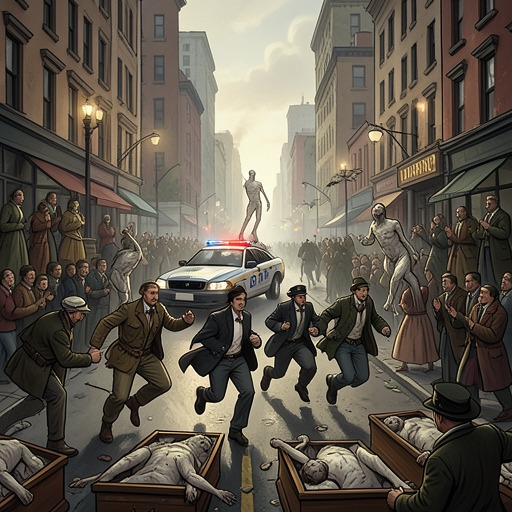
The enclosure is finished at half past two in the morning, and military personnel fill the cemetery. The opening of the coffins then reveals a repeated pattern: the dead fumble uncertainly toward a way out, and many attempt to elude the military before being brought back. The soldiers’ task is not simply to uncover remains but to confront people who move without the expected signs of life and cannot be treated as ordinary corpses. Restraint is the immediate answer, even as the nature and status of those being restrained remain unsettled.
The scale of the emergency soon exceeds the operation’s initial arrangements. Three more bodies are dug up before ambulances arrive. Quarrels break out in several areas, and commanding officers have to intervene in multiple fights. By the time the report is prepared, the cemetery has descended into chaos; a few of the dead may have escaped, and residents nearby are told to keep their doors locked. The plan is to open the remaining graves that day and continue at the other eighteen city cemeteries. That intended expansion stands in sharp contrast to the disorder already visible at the first site: the military operation has produced a temporary enclosure, but not secure control of every person emerging from the graves.
Relocation to the Heath
On 16 August, the Government of Sweden announces that military personnel have relocated the reliving during the night. The move takes place after all staff have left Danderyd Hospital and military vehicles have gathered outside its entrances. The Prime Minister presents the relocation as necessary to provide proper care and says the reliving have been moved to a facility where they can be kept separate. Medical personnel’s concerns about mental stress, the speech says, must be taken seriously.
The announcement also describes an alternative that was considered: distributing the reliving among several hospitals. That plan was rejected because it would have compromised regular health services and reduced the level of care. Instead, the authorities chose the Heath, a residential area in north-west Stockholm, and dispatched the necessary personnel. The stated aim is for rehabilitation to begin shortly and for the reliving to be given a place in society. The speech does not explain the practical details of the move or the military’s role beyond carrying it out. Its public account therefore places the operation between coercive separation and a promised longer-term provision of care.
Role and Limits
Across the two operations, the Swedish Military acts where ordinary arrangements have failed: graves must be opened, emerging bodies contained, and hospital patients moved to a separate site. Its personnel use the tools immediately available—numbers, an enclosure, physical restraint, and transport—while the institutions responsible for explaining the crisis struggle to define what has happened. At the cemetery, the soldiers encounter the returned dead as bodies that can be restrained but whose movement defeats the assumptions built into burial. At the Heath, relocation is described in the language of care and rehabilitation, though separation remains central to the measure.
The account does not present the military as having solved the crisis. The cemetery operation’s uncertain escapes, fights, and delay before ambulances arrive expose the limits of control, while the later announcement gives no evidence yet that the promised rehabilitation has begun. The institution’s significance lies in this uneasy transition: it enforces immediate physical order, but cannot by that action alone settle whether the dead are patients, relatives, threats, or members of society who must be accommodated.